DEVELOPMENT WEBSITES · 7 MIN
One website per development or one for the whole company?
A dedicated website for each development or pages on the company website? We compare both models on SEO, maintenance, brand and life after sell-out, and show a middle way.
Skyverse
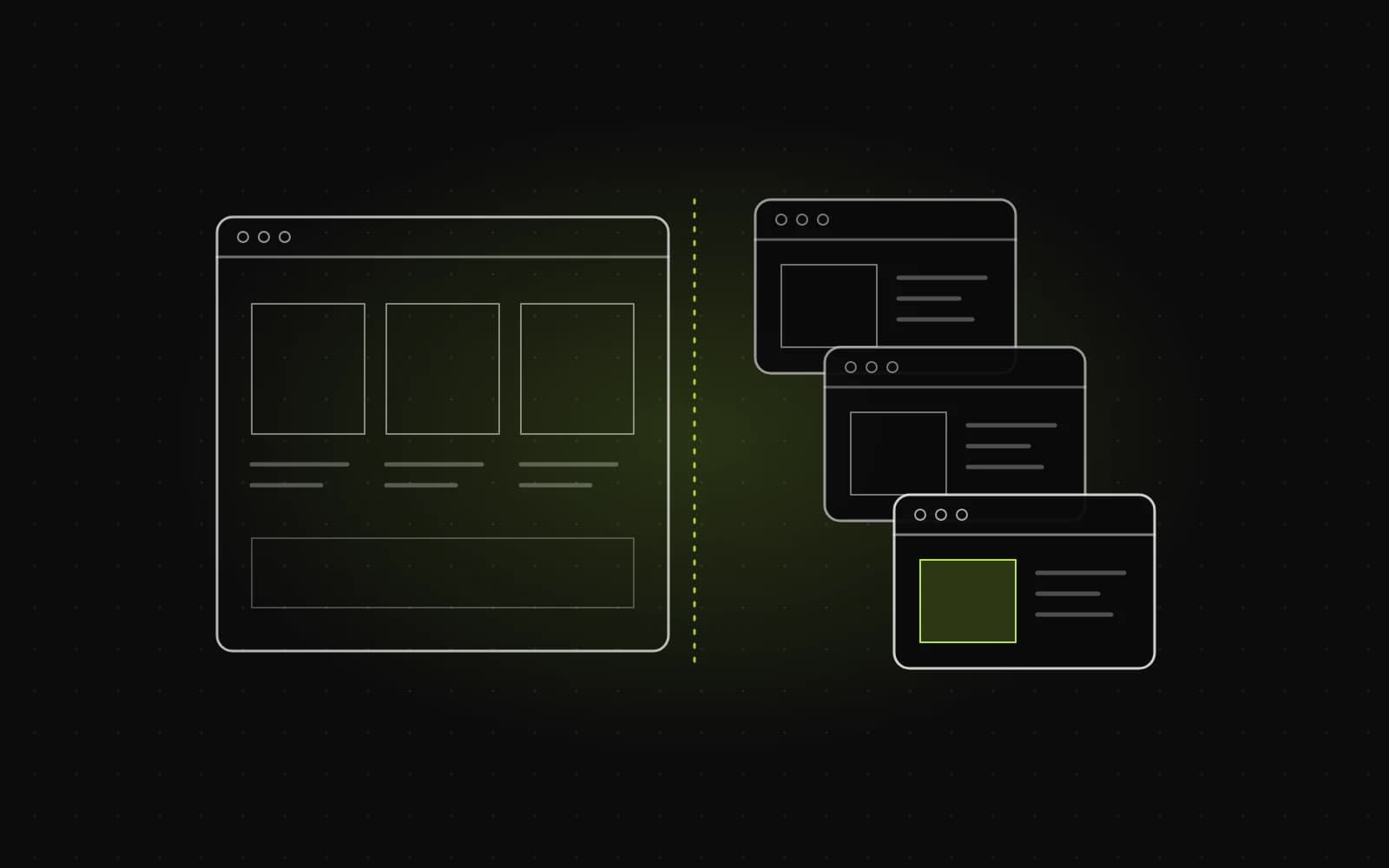
By their second or third development, almost every property developer faces the same question: should the new development get its own website on its own domain, or a section on the company website? Both routes work, but for different companies. The choice affects visibility in Google, maintenance costs, the sales team's daily work and what happens to the website once the last unit is sold.
Below we compare both models and a middle way that combines the strengths of each.
The two models in brief
A dedicated development website has its own domain (for example developmentname.com), its own visual identity and a whole site devoted to one building or estate.
A company website with development pages has one domain for the developer, a shared look and a list of developments, each with its own detailed page and list of units.
When a dedicated website makes sense
A website of its own makes sense when the development is a brand in its own right. That is often the case with historic tenement houses, premium projects and developments whose name is a well-known address in the city. Buyers then search for the development's name, not the developer's.
An example from our work: Koneser Group sells tenement houses in Kraków's Kazimierz and Stradom districts, and each has its own identity and website: Skałeczna 1/3/5/7 and Agnieszki 9. We deliberately designed the Agnieszki 9 brand separately from the developer's other tenements, because each building has a different character and tells a different story.
A dedicated website also gives complete freedom over the content. The Skałeczna website guides three groups of buyers, people buying a home for themselves, investors and future tenants of the retail units, each along a different path. That would be harder on a company website squeezed into a template shared by every development.
The price is maintenance. Every website means a separate domain, hosting, certificate, updates and backups, separate analytics, a consent banner and a privacy policy. For one development that is a detail. With five websites, each built differently and by someone else, it becomes a fixed cost and a risk that one of them is forgotten when security updates are due.
When one company website is better
One company website works well when a developer runs several developments in a similar segment and its name is itself a sales argument: buyers trust a company that has already completed several buildings.
The main advantages:
- One admin panel, one form, one set of analytics. The sales team learns one tool, and enquiries from every development land in one place.
- Buyers see the whole offer. If one development has no three-room apartments left, the website can point straight to another.
- A new development starts with the domain's track record. A page on a website Google has known for years usually starts showing in search results sooner than a brand-new domain.
- A lower cost per new development. A new page reuses existing building blocks: the apartment search, the unit page, the enquiry form.
An example is the ICON Development company website: a list of developments, separate pages for individual projects and a WordPress admin panel where the client updates content and the offer without help. The same foundation is used to build websites for further developments.
The weak point of this model is less room for character. If every development looks like another row in the same template, it is harder to show what makes one different from the next.
SEO: what actually changes
Buyers search for the development's name, the developer's name or phrases such as "new apartments" plus a district. Both models can rank well for the development's name, as long as the website or page has its own title, description and content.
The difference shows with general phrases. A new domain starts with no history and no links from other websites, so it needs time to build visibility. The domain name alone, even one containing "apartments", no longer gives much of an advantage. A page on the company website benefits from everything the developer's domain has built up over the years, provided it has its own unique content rather than a copied template with a different name.
One thing to avoid in either model: the same content at two addresses, for example a full copy of the development website on the company website. The two pages then compete with each other in search results.
After the last unit is sold
It is worth asking this question at the start, not at the end. Under Article 19a of the Polish developer act, a developer must keep its own website with unit prices from the start of sales until the rights from the last agreement for the development are transferred to the buyer. We explain this obligation in Housing price transparency: what a developer's website must show. So a website with prices cannot be switched off on the day the last apartment is sold.
After that, a dedicated website loses its purpose, but its domain does not. Over the years it has collected links and visits. A good solution is to redirect it to the development's page in the developer's portfolio and keep the domain registered so nobody else can take it over. On a company website it is simpler: the development moves to completed projects and keeps working as proof of the company's experience.
A shared offer and CRM, whatever the model
However many websites there are, the data should live in one place: units, prices, statuses, price history and enquiries. If each website has its own database of units, a single price change means edits in several admin panels, in portal listings and in the sales team's spreadsheet.
That is how it worked at Koneser Group before we built Listing Manager: every change of price or status meant corrections in listings, in the export and on the development websites. Today a unit's price or status is changed once, and the development websites update themselves through a WordPress plugin. Listings go to the property portals from the same place, and enquiries and statistics appear in one view. With that in place, the number of websites stops being a problem for the sales team.
The middle way: one foundation, several websites
Often the best compromise is a hybrid. The developer has a company website with the full offer of every development, and selected developments with a strong brand of their own get a dedicated website. Both are built on the same foundation: the same building blocks, the same admin panel, the same apartment search and one source of data.
Each development then gets its own colours, logo and copy, while the company maintains one system instead of several. The next website is quicker to build because most of the work is already done. After sell-out, the development returns as a page in the portfolio and its domain redirects visitors there.
Five questions before you decide
- How many developments are you selling at once, and how many are planned for the next few years?
- Does this development have a brand people search for by name?
- Does your company's name help sell on its own?
- Who will update prices and statuses, and in how many places?
- What will happen to the website and the domain once the last unit has been handed over?
Summary
A dedicated website works for developments with a strong brand of their own. One company website is cheaper to maintain and makes better use of the domain's track record. The middle way combines both, provided there is a shared foundation and one source of unit data behind it. Whichever you choose, check that the website has everything a buyer needs: our development website checklist will help.
We build both development websites and developers' company websites, and we build websites for further developments on the same foundation. See our website and care and development services, or tell us about your development.